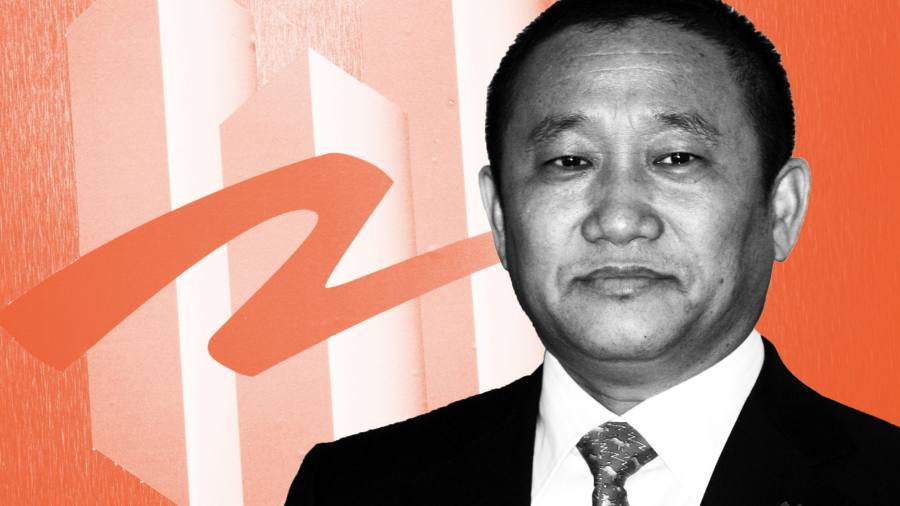

When Zhongwang Holdings made the prestigious acquisition of an Australian superyacht builder in 2017, it represented the high-water mark of the Chinese aluminium processor’s ambitions. Five years on, the tide has turned dramatically in its fortunes, with Zhongwang declared bankrupt last month and leaving more than $60bn in debt.
Its founder and former chair, Liu Zhongtian, said at the time that the deal to buy SilverYachts would help the company take on the marine sector “at full speed”, introducing its extruded aluminium to high-end boat building. Instead, it has become part of the company’s cautionary tale of debt-fuelled binge buying that contributed to its downfall.
Once Asia’s biggest manufacturer of aluminium extrusions, Zhongwang thrived in the 2000s as China’s booming property sector created strong demand for its products in construction. Then, as the economy cooled, its business started to collapse, a victim of its own overexpansion and leveraged asset buying.
In September, a court in Shenyang in north-east China approved an application for bankruptcy by Zhongwang’s creditors. The company said it had been notified that its 252 affiliates and parent would enter consolidated restructuring, as it was unable to pay its debts.
Zhongwang was now “manifestly insolvent”, the court said, citing a report from Hong Kong-based auditor Mazars that detailed liabilities of Rmb459.8bn ($64bn) at the affiliates by the end of March, while their total assets stood at just Rmb202bn.
Zhongwang’s Hong Kong-listed unit has not released its 2021 annual report and first-half report for 2022. Its market capitalisation went from a HK$30bn (US$3.8bn) peak in July 2019 to HK$9bn in August 2021, when trading of shares was suspended and never resumed.
“The collapse of Zhongwang was shocking but not surprising to people in the commodity industry,” said Eugene Weng, a Shanghai-based attorney at the firm Wintell & Co. “Volatility in the global commodity market this year and the company’s poor corporate governance are the straws that broke the camel’s back.”
Zhongwang helped make its founder the richest man in China’s north-eastern rustbelt province of Liaoning between 2014 and 2017, according to data compiled by Forbes.
Liu had diversified the company’s business to spur growth, expanding production lines in the coastal city of Tianjin in 2016 to service increasing demand from the aerospace, marine and vehicle sectors. It made its first overseas acquisition in September 2017, when it took over Germany’s Aluminiumwerk Unna, a maker of seamless tubes used in aircraft.
But Zhongwang’s offshore expansion soon drew scrutiny from overseas regulators. In the same year it bought the German company, Zhongwang dropped a planned $1.1bn acquisition of US aluminium maker Aleris after the Committee on Foreign Investment in the US raised national security concerns.
In 2019, US prosecutors accused six southern California companies tied to Liu of evading $1.8bn in import duties on aluminium. They claimed that between 2011 and 2014, the company sold 2.2mn aluminium pallets to a US entity controlled by Liu, with melting facilities built to turn the pallets back into commercial products and sales made to shell companies to inflate the company’s financial position.
Liu, who stepped down as chair in 2017, was described as “a corrupt businessman” who had defrauded the US out of billions of dollars of tariffs due on Chinese imports.
The six companies were ordered to pay $1.83bn in restitution this year in a judgment, but neither Zhongwang Holdings representatives nor Liu appeared in court and China Zhongwang remained a “fugitive”, said the US justice department.
Liu could not be reached for comment and Zhongwang did not offer comment for this article, although the company said last year that its controlling shareholder, Liu, had confirmed he did not control nor was he a beneficial owner of the six companies.
Along with overseas deals, there were domestic investments in the financial sector to help fund expansion. The company effectively financed itself, sourcing credit from Zhongwang Finance, a subsidiary that went into bankruptcy on the same day as its parent.
“The [lesson from] the fall of Zhongwang is the failure to crack down on these alleged self-financing activities. Such practices are a ticking time bomb and can hardly be tolerated by Chinese courts,” said Weng.
The restructuring ordered by the court aims to “preserve the aluminium supply chain built and achieved by the 253 Zhongwang entities”. Its manufacturing base in Tianjin is still operating with local government support and continues to produce boards for vehicles and aluminium cans, according to Wan Ling, aluminium analyst at CRU, a commodities market intelligence company.
The company has also tried to show that its manufacturing capability is still intact. It announced a supply deal with South Korea’s Hyundai Rotem, a train manufacturer, days ahead of the court ruling and promised deliveries by the end of the year.
However, the bankruptcy has exposed the weaknesses of the conglomerate business model that Zhongwang pursued, and many contractors and creditors have been hit by its collapse. Liquidating assets could also prove difficult, given manufacturing has been weakened by China’s strict zero-Covid policy, said Weng.
“Everything would have been fine if Zhongwang had kept up its pace of growth and development,” he added. “However, when the music stopped, Zhongwang was in trouble.”
Read the full article here